There's a city in the mountains of southern British Columbia with a population of about 700 people. It has a post office, a museum, a few blocks of historic downtown buildings, and a restaurant now in its second year. It also has a title that no other place in Canada can claim: the smallest city in the country. This is Greenwood. And its story is one of the most remarkable in the Canadian West.
How does a place with fewer people than most apartment buildings keep its city charter? How does a town survive when the industry that built it vanishes? And what holds a community together through more than a century of boom, bust, war, and reinvention? The answer, as it usually is, comes down to people — and the places where they gather.
Born in the Boom
Greenwood was incorporated as a city on July 12, 1897, at the peak of the Boundary Country copper rush. The timing was audacious — the townsite had only been laid out two years earlier by founder Robert Wood — but the optimism was justified. Copper and gold deposits in the surrounding hills were attracting investment from around the world, and the new city grew at a staggering pace.
By 1899, Greenwood had a population approaching 3,000. It had banks, hotels, churches, a newspaper (the Greenwood Miner), a courthouse, and all the infrastructure of a proper city. The BC Copper Company smelter was under construction on the edge of town. The Mother Lode mine was producing ore. And the streets — Copper, Gold, Silver, Deadwood — told you everything you needed to know about what drove the local economy.
It was a real city, with real ambitions. The people who lived there weren't just passing through — they were building something. Families put down roots. Merchants invested in brick buildings meant to last generations. The city council planned for a future that seemed limitless. Greenwood wasn't just another mining camp. It was going to be a metropolis.
The Long Decline
The boom didn't last. Copper prices collapsed after World War I, and the BC Copper Company smelter shut down in 1918. The Mother Lode mine closed. The population began a slow, painful decline that would continue for decades. By the 1930s, Greenwood was a shadow of its former self — the grand brick buildings still stood, but many of the storefronts were empty. The city that once rivaled its neighbors was barely hanging on.
But Greenwood refused to die. The remaining residents dug in. They found work in logging, ranching, and small-scale mining. They maintained the city's incorporation — a point of fierce local pride — even as the population dropped to levels that would have meant dissolution anywhere else. Greenwood wasn't going to become a ghost town. Not on their watch.
1942: The Internment
And then the war came, and with it, one of the darkest chapters in Canadian history — one that would transform Greenwood in ways nobody could have predicted.
In early 1942, following the attack on Pearl Harbor, the Canadian government ordered the forced removal of over 22,000 Japanese Canadians from the BC coast. Families were torn from their homes, businesses were seized, and entire communities were uprooted overnight. The displaced were sent to internment camps and ghost towns scattered across the BC interior. Greenwood was one of those places.
Over 1,200 Japanese Canadians were relocated to Greenwood — more than doubling the town's existing population virtually overnight. They arrived to a struggling city with empty buildings and limited services. The government housed them in converted hotels, vacant storefronts, and hastily constructed housing. It was a forced relocation born of wartime fear and racism, and the conditions were harsh.
But something unexpected happened in Greenwood. Unlike some internment locations where hostility and segregation prevailed, the people of Greenwood and the Japanese Canadian internees gradually built genuine community bonds. The newcomers opened businesses, taught judo and Japanese language classes, formed baseball teams, and contributed to the civic life of the town. Japanese Canadian children attended the local school. Families formed friendships that would last lifetimes.
After the war, when the internees were finally allowed to leave, many chose to stay in Greenwood or remained deeply connected to the community. The Japanese Canadian experience is memorialized today at the Greenwood Museum, where photographs, personal items, and oral histories preserve this complex, painful, and ultimately human story. A heritage walking tour marks the buildings where internees lived and worked. It's a chapter that Greenwood doesn't hide from — it's part of who the town is.
Resilience Is a Way of Life
The decades after the war brought more challenges. The logging industry boomed and contracted. Small mines opened and closed. Young people left for the cities. The population continued its slow decline. By the late 20th century, Greenwood had settled into its current identity: a tiny, resilient city of about 700 souls, officially the smallest city in Canada, holding onto its charter with a combination of stubbornness and pride that only the people of the Boundary Country could muster.
But here's the thing about Greenwood: it has never stopped being a community. The people who live here know each other. They show up for each other. They support local businesses not because it's trendy, but because that's how you survive in a place this small. When you only have 700 people, every single one of them matters. And every gathering place — every restaurant, every pub, every community hall — is a lifeline.
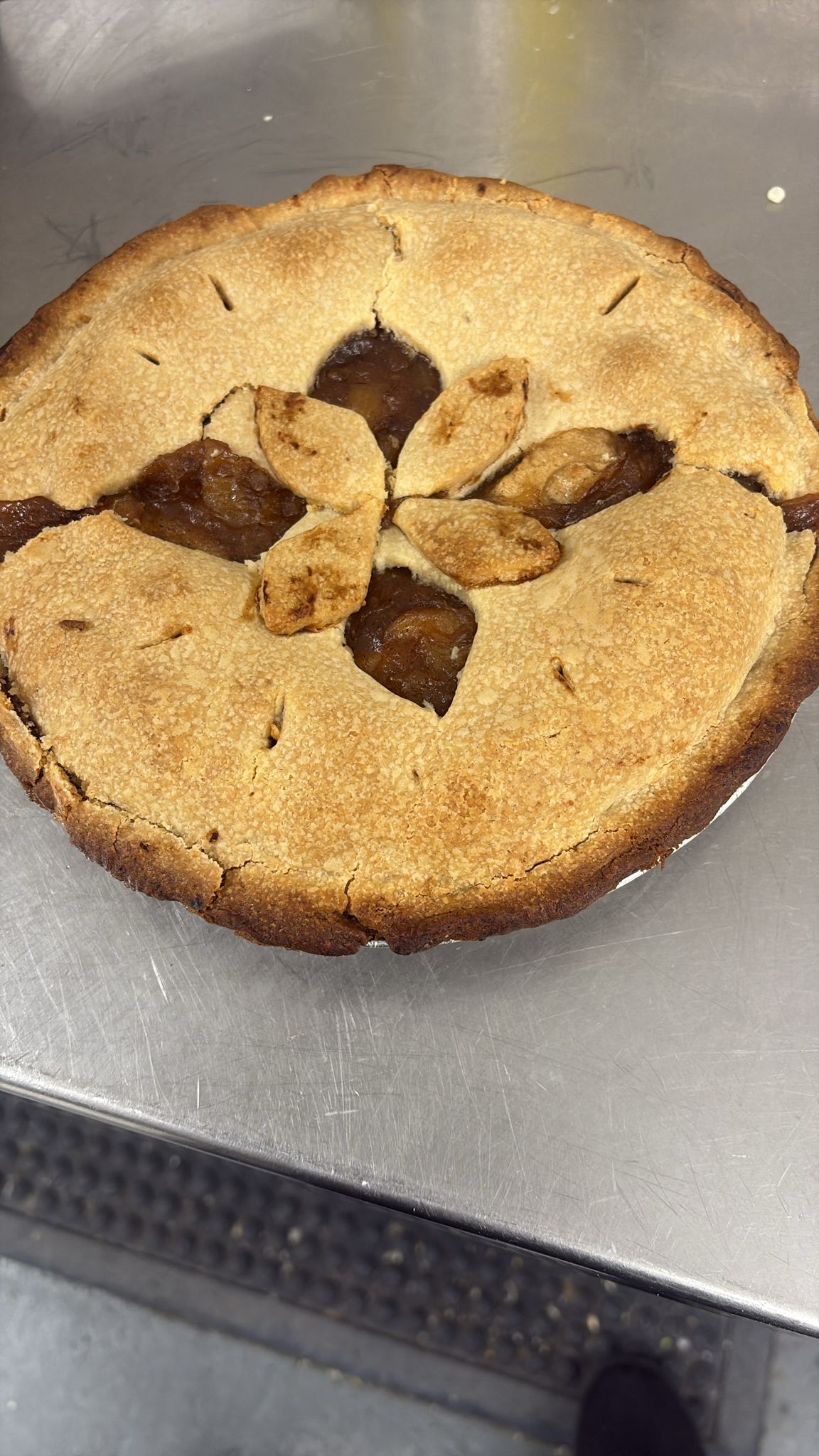
The famous apple pie at Mama's Grill — baked fresh and gone fast
Breaking Bread Together
That's where Mama's Grill comes in. Now in our second year, Mama's Grill is feeding this community. Not just serving food — feeding people. There's a difference. When you run a restaurant in the smallest city in Canada, you quickly get to know your customers' names. You know their families. You know their stories. You know what they order before they sit down. You know who needs an extra-large coffee on Monday morning and who's going to want a slice of pie to take home.
Mama's Grill is the kind of place that every small town needs but few are lucky enough to have. It's where the old-timers come for coffee and gossip. Where families celebrate birthdays and milestones. Where travelers passing through on Highway 3 get their first taste of Boundary Country hospitality. Where a plate of food is more than just a meal — it's an invitation to sit down, slow down, and be part of something.
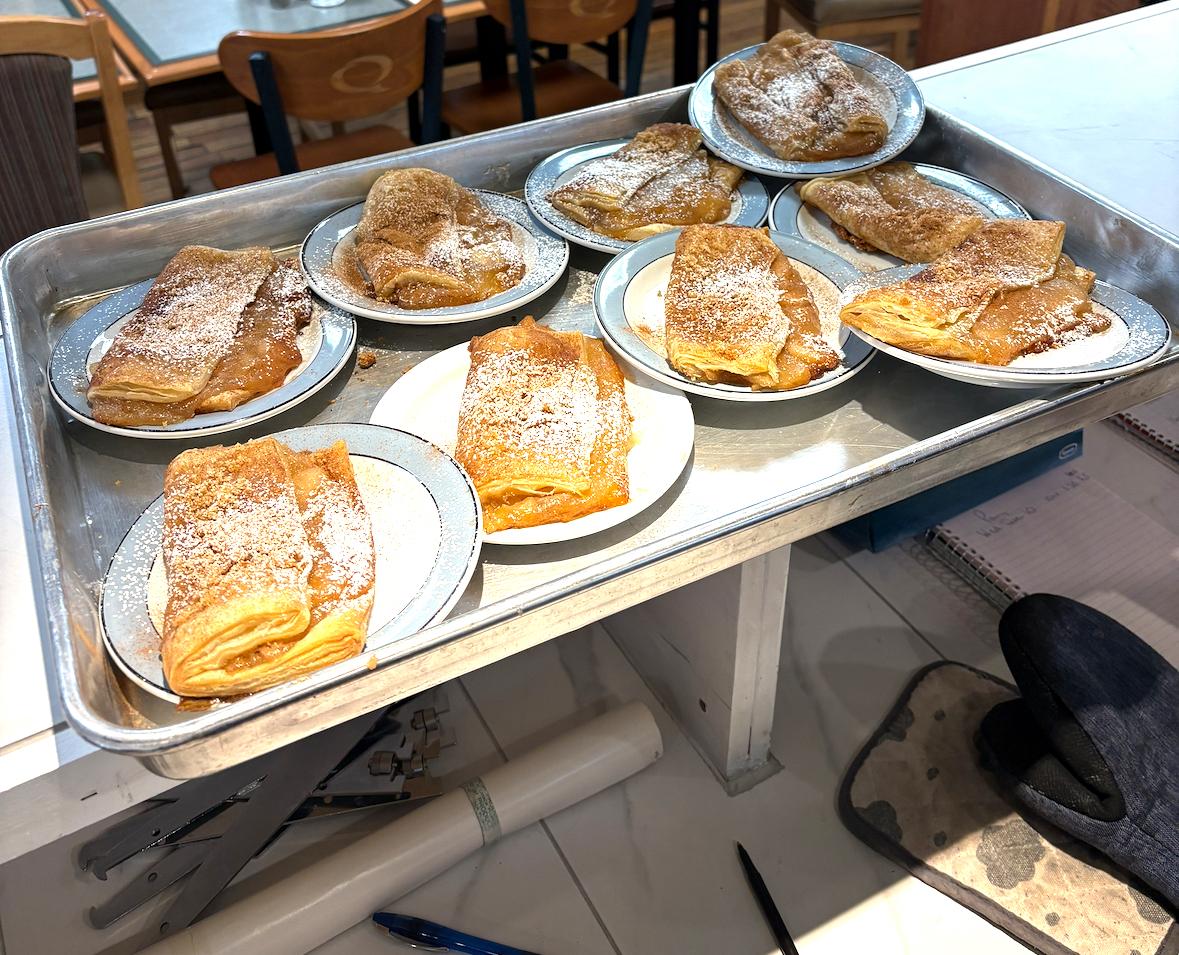
Mama's bougatsa — a Greek custard pastry that's become a Greenwood legend
The Pie, the Bougatsa, and the Pot Pie
If you want to understand what Mama's Grill means to Greenwood, look at the baked goods. The apple pie at Mama's is legendary — baked fresh, with a flaky crust and just the right amount of sweetness. People have been known to call ahead to reserve a slice. The bougatsa — a traditional Greek custard pastry wrapped in crispy phyllo — is the kind of thing you'd expect to find in Athens, not a 700-person city in the BC mountains. And the pot pies? Golden-crusted, stuffed with meat and vegetables, rich and warming — the kind of thing that makes you forget it's minus twenty outside.
These aren't just menu items. They're acts of care. Every one of them is made by hand, with real ingredients, by someone who takes pride in the craft. In a world of factory food and chain restaurants, that means something. In a town that has survived everything the last 127 years have thrown at it, it means everything.
Come for the Food, Stay for the Stories
Greenwood's story isn't over. It's still being written, every day, by the people who choose to live here, work here, and invest in this place. The miners are a memory. The internment camp is a museum exhibit. The logging trucks still rumble through, but the boom days are history. What remains is something more valuable than copper or gold: a community that refuses to quit.
Mama's Grill is part of that story. Thirty-plus years of opening the doors, firing up the grill, and feeding the people of the smallest city in Canada. Thirty-plus years of early mornings and late nights, of regulars and strangers, of pie and coffee and conversation. It's the kind of legacy that doesn't make the history books but holds a town together just the same.
Come to Greenwood. Walk the heritage streets where copper millionaires once strode and Japanese Canadian families rebuilt their lives. Visit the museum. Read the plaques. Take in the mountains. And then do what people have been doing in this valley for over a century: sit down at a table, order a meal, and break bread with your neighbors. Mama's Grill, 298 South Copper Avenue. Come for the food. Stay for the stories. You'll leave understanding why the smallest city in Canada has the biggest heart.